
If you’re a bilingual professional in Latin America looking for career stability with real growth potential, the legal field offers exactly that, and so much more. It’s a path where your skills, dedication, and cross-cultural expertise can open doors to meaningful remote opportunities with U.S.-based law firms.
We’re here to guide you through every step, from understanding education requirements and building in-demand skills to acing interviews and confidently negotiating offers that reflect your worth. You’ll learn how to position yourself as the candidate firms want. Leverage your existing professional experience. Even if you’re new to legal work, this guide will help you get started.
Key Takeaways
- Education: Most roles require an associate degree or a paralegal certificate, though larger firms prefer bachelor’s degrees.
- Core Skills: Success requires proficiency in legal terminology, case management software (e.g., Clio), and strong bilingual communication skills.
- Salary Growth: Experience and specialized certifications (such as ACP) are the primary drivers of higher compensation.
- Remote Opportunities: Over 60% of law firms now support remote/hybrid roles, making this a viable path for international bilingual professionals.
- Entry Strategy: Candidates without experience can break in by leveraging transferable administrative skills and volunteering at legal aid clinics.
What Does a Legal Assistant Do?
Legal assistants support attorneys by maintaining and organizing case files, conducting legal research, drafting documents, and coordinating schedules, essential work that keeps every matter on track. To get hired, you’ll typically need at least a two-year associate degree in paralegal studies or a related field, plus sharp attention to detail, strong writing skills, and complete professionalism with confidential information.
Legal assistants bridge administrative support and substantive legal work. You’ll support attorneys by drafting documents, managing files, and coordinating schedules, allowing them to focus on the core aspects of each case. Legal processes depend on your expertise; attorneys rely on skilled legal assistants to keep cases moving forward efficiently and professionally.
Daily administrative tasks
- Manage attorney calendars, scheduling court appearances, and coordinating client meetings
- Answer phones, greet clients, and handle correspondence between attorneys, courts, and opposing counsel
- Master both physical document filing and digital record management
- Maintain organized, efficient systems essential to legal practice operations
Legal research and document drafting
Beyond scheduling and filing, you’ll dive into legal research using databases like Westlaw or LexisNexis. Attorneys rely on you to find relevant case law, statutes, and regulations that support their arguments.
You’ll also draft correspondence, prepare discovery documents, and assist with basic legal filings. While attorneys review and finalize everything, your initial work saves them hours and lets them focus on strategy.
Client communication and case management
You’re often the first person clients speak with when they call. You’ll conduct intake interviews, gather essential information, and explain next steps in the legal process.
Managing case files means tracking every document, coordinating with expert witnesses, and making sure all parties have what they need before hearings. Strong communication keeps cases moving forward and clients feeling informed.
Legal Assistant Qualifications and Certifications
Educational requirements vary by employer. Most legal assistant positions expect some formal training. As you explore your options, you’ll typically encounter:
- Degree or certificate requirements
- Specialized legal skills training
- State-specific regulations
Associate vs. bachelor’s degrees
| Degree Type | Duration | Best For |
| Associate Degree | 2 Years | Focused training in legal procedures and software; ideal for entry-level roles at smaller practices. |
| Bachelor’s Degree | 4 Years | Broader knowledge (Criminal Justice, etc.); preferred by large firms and corporate legal departments. |
According to the U.S. Bureau of Labor Statistics, an associate degree is also the typical entry-level education for legal assistants in the United States.
Paralegal certificates and micro-credentials
If you already hold a bachelor’s degree in another field, whether it’s marketing, business, or communications, certificate programs offer an efficient pathway into legal work without starting your education from scratch. These intensive programs usually last six months to one year. They cover essential skills for legal assistants:
- Research
- Writing
- Case management
- Legal software
Online options offer flexibility for working professionals. Many programs have specialized tracks in areas like:
- Litigation support
- Corporate law
- Real estate law
Continuing education through professional associations keeps your skills current as technology and legal practices evolve.
State-specific and barassociation requirements
Some states regulate legal assistant and paralegal roles. You may need specific certifications or registrations. For example, California has detailed education and experience requirements for paralegals. Other states are more relaxed.
Take time to research your target state’s bar association website. Understanding local regulations early helps you plan your education and certification path strategically and avoid costly missteps down the road. Even in states without formal requirements, voluntary certifications, such as the Certified Legal Assistant (CLA) credential, demonstrate your commitment to potential employers.
Key Skills to Become a Legal Assistant
Beyond technical knowledge, employers seek professionals who bring a complete skill set to the table, capabilities that make you not just competent, but truly effective in fast-paced legal environments:
- Legal terminology and writing: Communicate precisely using legal vocabulary and follow strict formatting and proofreading standards.
- Software proficiency in practice-management tools: Use systems like Clio, MyCase, Microsoft Office, e-filing, and document management software to organize legal work efficiently.
- Soft skills in organization and communication: Manage multiple cases, deadlines, and sensitive information with attention to detail, professionalism, and strong client interaction.
Legal terminology and writing
You’ll work with essential legal terminology daily, terms like ‘discovery’ (the evidence-gathering phase), ‘deposition’ (sworn testimony outside court), ‘motion’ (formal requests to the judge), and ‘pleading’ (official court documents). Mastering this vocabulary helps you communicate with precision and follow complex proceedings with confidence.
Legal writing follows strict formatting rules. You’ll learn citation styles, proper document structure, and how to draft clear correspondence. Strong proofreading catches errors that could undermine a case or damage client trust.
Software skills for practice-management tools
Case management systems like Clio or MyCase help you track deadlines and organize files. Document review platforms manage large volumes of evidence, while billing software ensures accurate time tracking.
Familiarity with Microsoft Office, especially Word and Excel, is essential. Many firms also use e-filing systems to submit documents directly to courts, so comfort with digital workflows helps you hit the ground running.
Soft skills in organization and communication
Attention to detail prevents costly mistakes, while strong organizational systems help you stay on top of everything. Professional communication builds trust with clients, opposing counsel, and court staff. Professional discretion is fundamental to your role; you’ll be trusted with sensitive client information daily, and maintaining confidentiality demonstrates the integrity that defines exceptional legal assistants.

Average Salary and Job Outlook
Across the United States, the U.S. Bureau of Labor Statistics lists a median annual wage of 61,010 USD (about 29.33 USD per hour) for legal assistants. Compensation still varies by location, firm size, and experience, but the field offers stable employment and clear advancement paths.
Entry-level salary ranges
Nationwide, entry-level legal assistants typically start at about 61,010 USD per year (29.33 USD per hour), before geography and employer type come into play. Your starting salary will reflect three key factors: geographic location (major metropolitan areas typically offer higher compensation), firm size (larger firms and corporate departments often pay premium rates), and your educational credentials (bachelor’s degrees and specialized certifications command higher starting salaries). Legal assistants in major metropolitan areas typically earn more than those in smaller markets, reflecting higher living costs.
Large firms and corporate legal departments often pay more than small practices or nonprofit organizations. Your education level also matters; candidates with bachelor’s degrees or specialized certifications often command higher starting rates. [Bureau of Labor Statistics]
Factors that increase your salary
As you build experience and develop specialized expertise, your value to employers grows, and so does your earning potential. As you develop expertise in specific practice areas or master complex software systems, your value to employers grows.
Additional certifications, such as the Advanced Certified Paralegal (ACP) credential, demonstrate specialized knowledge. Bilingual skills, particularly fluency in English and Spanish, make you especially valuable to firms serving diverse client populations.
Career paths toward paralegal or law school
Many legal assistants advance to senior paralegal roles with greater responsibility and higher pay. Some specialize in areas like intellectual property, real estate, or litigation support, becoming subject-matter experts.
Others use their experience as a stepping stone to law school, having gained invaluable insight into legal practice. The skills you develop, research, writing, and case management, translate directly to law school success. As you gain experience, you might also explore specialized paralegal certifications in high-demand areas such as intellectual property, corporate compliance, or litigation support, which position you for senior-level roles and premium compensation.
The same BLS outlook projects little to no change in overall employment through 2034, with steady demand expected in areas like litigation support and corporate compliance.
Industries and Work Settings Hiring Legal Assistants
Legal assistants work across diverse settings, each offering unique advantages. Exploring your options helps you find environments that align with your interests and lifestyle preferences.
Law firms and corporate legal departments
Private law firms remain the largest employers of legal assistants, ranging from solo practitioners to international firms. Small firms offer variety and direct attorney interaction, while large firms provide structured training and advancement opportunities.
Corporate legal departments hire legal assistants to support in-house counsel, often offering regular hours and comprehensive benefits. Practice areas vary widely, including litigation, family law, personal injury, and corporate transactions, each with its own pace and requirements.
Government and nonprofit organizations
Public sector positions include roles at district attorney offices, public defender offices, and regulatory agencies. Government positions often offer job stability, good benefits, and the satisfaction of public service.
Nonprofit legal aid organizations serve low-income clients and underserved communities. Government and nonprofit positions offer distinct advantages, including job stability, comprehensive benefits, and the meaningful satisfaction of public service, though compensation may be lower than in private sector roles. For many professionals, the trade-off brings greater work-life balance and purpose-driven work.
Virtual law firms and freelance services
Remote legal assistant positions have grown significantly since 2020, as digital transformation in legal services accelerated during and after the pandemic. According to the 2024 Gartner remote adoption report, over 60% of law firms now support remote or hybrid legal assistant roles. Virtual law firms operate entirely online, hiring remote staff to support attorneys across different locations.
Freelance legal assistants work on a contract basis, offering flexibility and variety. Remote roles require strong self-discipline and excellent communication skills, but they provide location independence that traditional offices can’t match.
Step-by-Step Guide to Get Hired as a Legal Assistant
Follow these seven steps to secure your role:
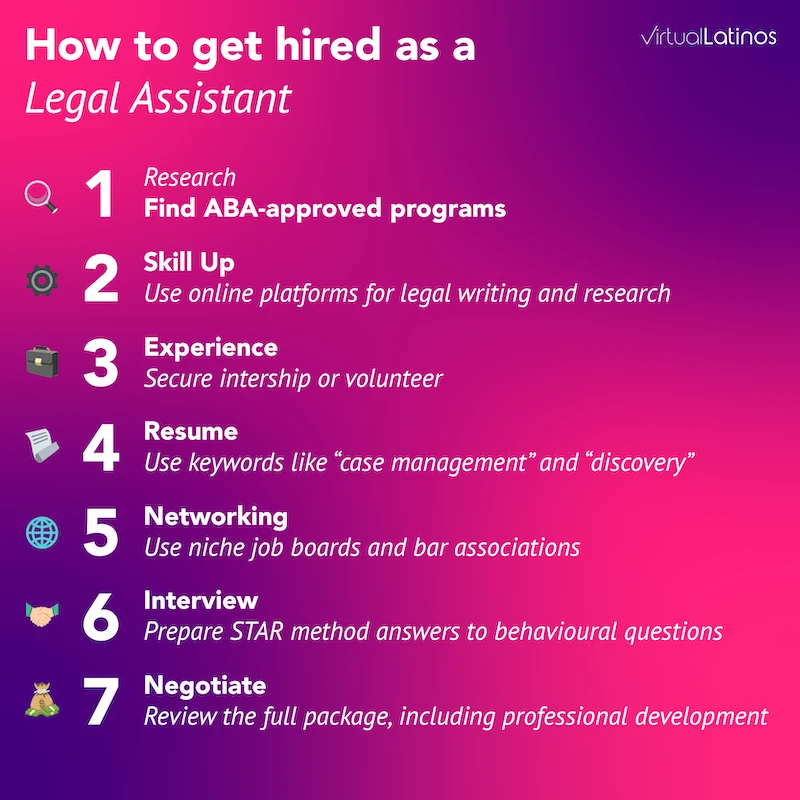
Landing your first legal assistant position takes strategic planning and consistent effort, but with the right approach, you can position yourself as the candidate firms want to hire. Let’s walk through your step-by-step roadmap to success.
1. Research education paths
Start by investigating paralegal programs at local community colleges, universities, and online institutions. Compare program lengths, costs, and outcomes; some schools publish graduate employment rates.
Look for programs approved by the American Bar Association, which ensures quality standards. Consider whether a certificate, associate, or bachelor’s degree best fits your situation. If you’re already working, online or evening programs offer flexibility.
2. Build core skills online
While pursuing formal education, supplement your learning with free online resources. Platforms like Coursera and edX offer courses in legal writing and research. YouTube channels explain legal terminology and procedures.
Practice using common legal software through free trials or student versions. Join online forums where legal professionals discuss industry trends and share advice. This proactive approach to learning does more than fill knowledge gaps; it demonstrates the initiative and resourcefulness that employers value while building the confidence you need to speak knowledgeably about legal processes in interviews.
3. Gain experience through internships and volunteer work
Practical experience sets you apart from other candidates. Many paralegal programs include internships as part of the curriculum. If yours doesn’t, seek opportunities independently at local law firms, legal aid clinics, or court systems.
Volunteer positions at nonprofit legal organizations provide hands-on experience while serving your community. Even volunteer experience strengthens your resume significantly, expands your professional network, and gives you hands-on insight into the day-to-day realities of legal work, helping you enter your first paid role with confidence and clarity.
4. Craft a targeted resume
Your resume is your first opportunity to demonstrate you understand what legal employers need, and that you’re ready to deliver it. Highlight relevant coursework, certifications, and any legal experience, even if it’s volunteer work.
Include transferable skills from previous jobs, organization, customer service, attention to detail, and deadline management, all of which matter in legal settings. Use industry keywords like “case management,” “legal research,” and “document preparation” to pass applicant tracking systems.
5. Apply to niche job boards and communities
Local bar associations often post opportunities. Network at paralegal association meetings and legal industry events. Here’s an insider reality: many of the best legal assistant positions are filled through professional referrals before they ever reach job boards. Building genuine relationships within the legal community doesn’t just accelerate your search; it opens doors to opportunities you’d never find otherwise.
6. Prepare for behavioral and skills-based interviews
Legal assistant interviews typically include questions about your organizational skills, ability to handle stress, and experience with confidential information. Prepare examples using the STAR method (Situation, Task, Action, Result) to demonstrate competencies.
Some employers test your software skills or ask you to complete a writing sample. Research the firm’s practice areas and recent cases to show genuine interest. Professional presentation matters, so dress conservatively and arrive early.
7. Negotiate your offer and onboard smoothly
When you receive an offer, review it carefully before accepting. Consider the full compensation package, including health insurance, retirement contributions, and paid time off.
Ask about training opportunities and professional development support. If the salary seems low, research market rates and negotiate respectfully. Once you accept, prepare for your first day by reviewing any materials the firm provides.
How to Become a Legal Assistant With No Experience
Starting your legal career without prior legal experience isn’t just possible, it’s a path many successful legal assistants have taken. What matters most isn’t where you’re starting, but how strategically you leverage your existing professional strengths and build the specific skills law firms value.
Leverage transferable admin skills
If you’ve built your career in marketing, sales, healthcare, or administration, you already possess skills that U.S. law firms actively seek, even if you’ve never worked in a legal setting. Your client relationship expertise, organizational capabilities, and attention to detail are exactly what make legal assistants invaluable.
Project management experience demonstrates your ability to juggle multiple priorities and meet deadlines. When applying, explicitly connect your previous work to legal assistant responsibilities, and show employers how your existing skills reduce their training burden.
Create sample legal documents
Building a portfolio demonstrates your capabilities even without formal experience. Use templates to practice drafting common legal documents, such as demand letters, simple contracts, and discovery requests.
Take online courses that include practical assignments. If you volunteer at a legal aid clinic, ask if you can use anonymized work samples with permission. This portfolio gives interviewers concrete evidence of your abilities.
Volunteer at legal aid clinics
Legal aid organizations serving low-income clients often welcome volunteers. You’ll work alongside attorneys and experienced paralegals who can mentor you and serve as references.
Volunteering also expands your professional network. Many volunteers receive job offers from the organizations they serve or from attorneys they meet through this work.
Find Legit Remote Jobs as a Bilingual Candidate
Remote legal assistant positions offer flexibility and access to opportunities beyond your local market. Bilingual candidates bring unique value to firms serving diverse client populations.
Highlight English–Spanish proficiency
Your bilingual fluency in English and Spanish isn’t just an asset; it’s a competitive advantage that sets you apart in the U.S. legal market. Law firms serving diverse communities actively seek professionals who can bridge language and cultural gaps with authenticity and expertise, and they’re willing to pay premium rates for this specialized skill.
Your language skills facilitate client intake, document translation, and courtroom interpretation. Emphasize this advantage prominently on your resume and in interviews. Consider obtaining certification as a legal interpreter to further strengthen your credentials.
Manage time zone and data security expectations
Remote legal work requires professional-grade technology and practices. You’ll need reliable high-speed internet, a private workspace, and secure systems for handling confidential information.
Time zone differences may require flexibility with your schedule if you’re working with firms in other regions. Familiarize yourself with video conferencing platforms, cloud-based case management systems, and secure file-sharing protocols.
Join trusted platforms like Virtual Latinos
The remote legal job market is full of opportunities, but not all of them offer the stability, fair USD compensation, and professional respect you deserve. That’s where connecting with the right platform makes all the difference. At Virtual Latinos, we connect talented bilingual professionals like you with legitimate, long-term remote opportunities at U.S.-based law firms that value your expertise and pay you fairly in USD, because you deserve more than gig work and race-to-the-bottom rates.
The platform vets employers to ensure they offer real, long-term opportunities with fair USD compensation. You’ll join a community of professionals who understand the unique challenges of cross-border remote work, with access to resources and support that help you succeed.
FAQs About Getting Hired as a Legal Assistant
How can international applicants validate their legal assistant credentials in the U.S.?
Research whether your home country’s legal education transfers to U.S. standards through the National Association of Legal Assistants or the American Bar Association. Consider taking U.S.-based paralegal certificate programs online to meet local requirements. Some states have specific regulations for foreign-trained legal professionals, so check your target state’s bar association website.
What technology setup do remote legal assistants need for client confidentiality?
You’ll need encrypted internet connections, preferably through a VPN, and password-protected devices with up-to-date antivirus software. Use secure file-sharing platforms approved by your employer rather than consumer services like personal email. Create a private workspace where others can’t see your screen or overhear confidential conversations.
How many hours per week do entry-level legal assistants typically work?
Most entry-level legal assistants work standard full-time hours, typically 40 hours per week. However, legal work follows court deadlines and client needs, so occasional overtime is common, especially in litigation before trials or during busy filing periods. During your interview process, ask about typical hours and overtime expectations.
How long does it take to become a legal assistant?
Your timeline depends on the education path you choose. A focused certificate can take as little as six months, an associate degree about two years, and a bachelor’s program around four years. Most employers hire candidates with a two-year associate degree plus an internship, so you can be job-ready in roughly 24 months.
What’s the difference between a paralegal and a legal assistant?
A paralegal handles substantive legal work, research, drafting, and case analysis, usually after completing specialized training or certification. A legal assistant focuses on administrative support like scheduling, filing, and basic client communication. Some firms blur the titles, but in general, paralegals work on the “legal what,” while legal assistants manage the “logistical how.”
How can I become a legal assistant with no experience?
Start with a short certificate or associate program to learn the basics of law, then volunteer or intern at a law firm or legal aid clinic. Highlight transferable skills, organization, customer service, and language fluency on your résumé, and create sample legal documents to show you understand the work. Many firms will train motivated beginners who show initiative.
Is being a legal assistant hard?
The job can be fast-paced because court deadlines and client needs rarely wait. You’ll juggle multiple tasks at once and may work overtime before big filings or trials. If you stay organized, communicate well, and set healthy boundaries, the work is challenging but manageable, and many assistants enjoy the variety it brings.
Launch Your Legal Assistant Career With Virtual Latinos
Starting your legal assistant career with the right support makes all the difference. Virtual Latinos connects talented bilingual professionals in Latin America with legitimate remote opportunities at U.S.-based law firms.
Apply today to join a purpose-driven community
When you join Virtual Latinos, you’re building a career with purpose. You’ll access exclusive legal assistant positions with firms that value your skills and respect your expertise.
Our community of over 10,000 Latin American professionals knows your journey firsthand, the frustration of competing on platforms that undervalue your skills, the isolation of working without mentorship or feedback, and the cautious hope that somewhere, there’s a legitimate opportunity that offers real growth, fair pay, and professional respect. Here, you’ll find the support, resources, and connections that help you thrive.