
Soft skills for remote professionals have evolved just as much as hard skills over time. However, technological advancements seem to have placed more emphasis on developing hard skills, which have changed significantly due to the efficiency gains brought about by digital transformation.
On the other hand, you might think that soft skills, since they aren’t directly tied to technology like hard skills, have remained the same since our parents’ generation. However, that’s not the case. Soft skills have also evolved to meet the demands of today’s job market. For example, teamwork, problem-solving, and emotional intelligence have become essential pillars in the business world in recent years.
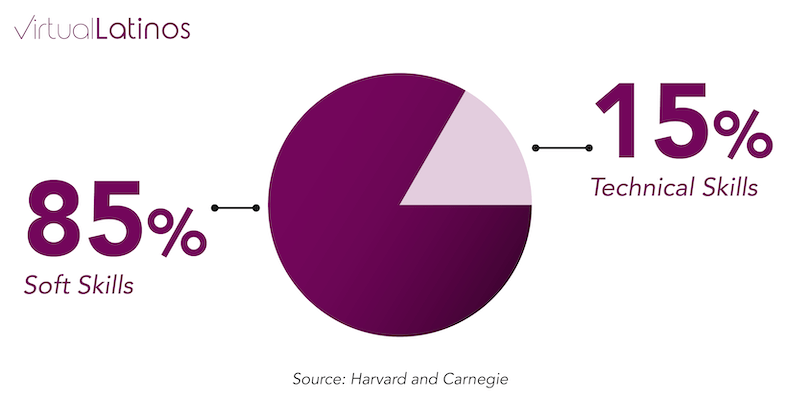
The truth is, soft skills are crucial for professional success. In fact, a study by Harvard, Carnegie, and Stanford found that 85% of workplace success is attributed to soft skills, while only 15% comes down to technical skills.
For virtual assistants looking to stand out in the remote work scene, building strong soft skills can truly be a game-changer.
To succeed in a competitive remote environment, you’ll need key soft skills and practical strategies to enhance communication, teamwork, and efficiency.
The Importance of Soft Skills for Remote Professionals
Soft skills are the building blocks for effective communication, collaboration, and productivity in a virtual workplace.
Consider, for a moment, the life of a remote professional. We’re often stationed miles away from our colleagues, with screens being our only windows to the work world. In such a remote environment, clear and concise communication becomes the lifeline, instrumental in navigating the unique challenges of virtual communication and collaboration.
The role of soft skills in remote work success
Far from being just trendy jargon, soft skills serve as the driving force behind the success of remote professionals, making soft skills important. These non-technical personal attributes, such as top soft skills:
- Communication skills: The ability to articulate ideas clearly prevents misunderstandings and builds rapport across teams.
- Time management: With the freedom of remote work comes the responsibility to self-manage schedules and deadlines.
- Adaptability: Quickly adjusting to new tools, team dynamics, or unexpected challenges is key to staying effective.
Employers increasingly recognize these important soft skills as indicators of a candidate’s ability to thrive independently and collaboratively.
Top Essential Soft Skills for Remote Workers
One common question we, as remote professionals, often encounter is: What are the most important soft skills for remote work? Let’s break it down.
Communication skills
Effective communication is the lifeline of remote work.
- Active listening: Engaging fully during calls or messages ensures clarity.
- Conflict resolution: Addressing misunderstandings proactively builds trust.
- Virtual meetings: Using project management tools like Asana ensures discussions stay focused and actionable.
Emotional intelligence
Emotional intelligence enhances team dynamics by enabling professionals to understand their own emotions and those of others.
- Empathy: Helps navigate cultural and personal differences within diverse remote teams.
- Self-regulation: Essential for maintaining focus and positivity in isolated remote work environments.

Time management and organization
Autonomy in remote work makes time management a non-negotiable skill.
- Use project management software to organize tasks and deadlines.
- Create routines, like morning check-ins and task reviews, to maintain focus and consistency.
Problem-solving and adaptability
Remote professionals need strong problem-solving skills to tackle challenges independently.
- Creativity: Thinking outside the box is crucial when immediate assistance isn’t available.
- Flexibility: Staying productive despite changes in project scope or timelines.
Leadership skills
Leadership in remote work extends beyond managerial roles.
- Trust-building: Foster open communication and delegate responsibilities effectively.
- Engagement: Regular check-ins and transparent processes keep teams aligned.
Digital literacy
A strong grasp of technology underpins success in any remote workforce.
- Familiarity with tools like Slack, Zoom, and Google Workspace is essential.
- Continuous learning ensures adaptability to emerging technologies.
Developing Leadership Skills as a Remote Professional
Leadership isn’t confined to the executive suite; it’s a skill that we can all develop as remote professionals. Even if you’re not in an official leadership position, developing leadership skills can help you maintain open communication and foster a sense of belonging in your remote team.
To effectively lead remote teams, it’s crucial to trust your team members, avoid micromanagement, and create clear processes with specific expectations for roles.
By setting specific expectations for your role and ensuring robust communication protocols within your team, you can develop your leadership skills and shine as a remote professional.
Leading virtual teams
Leading virtual teams is like conducting a symphony, where each member, often in different time zones, contributes their unique part towards a shared goal. To achieve this harmony, it’s essential to set clear goals, provide detailed instructions, and align team efforts with organizational objectives.
Open communication is key, involving regular check-ins, active participation in meetings, and sharing personal updates that may impact work. Additionally, using various communication tools and scheduling consistent virtual check-ins helps maintain connectivity and responsiveness.
Fostering a sense of belonging among remote team members can be achieved through personal engagement and attentiveness to individual needs.
Demonstrating initiative and responsibility
As remote professionals, we often find ourselves reliant on our devices, both in a literal and metaphorical sense. Demonstrating initiative and responsibility in such a setting involves:
- Proactively communicating about changes in one’s individual circumstances and priorities
- Seeking out solutions to challenges in projects
- Actively providing constructive feedback.
Taking responsibility also extends to our written communications. Here are some ways to demonstrate responsibility in our written communications:
- Ensure they are appropriately sensitive in tone
- Refrain from making negative judgments about others’ character
- Offer support to team members encountering performance issues
These actions show that we take responsibility for our words and their impact on others.

Strategies for Enhancing Your Soft Skills
Just like any other skill, improving soft skills requires ongoing learning and practice. The good news? There are countless ways to do just that. For starters, embracing continuous learning builds self-confidence and helps you identify new opportunities for career growth. Here, we share three strategies to achieve this.
Continuous learning
Enroll in online platforms like Coursera or Virtual Latinos Academy for tailored skill development.
The advent of the digital era has made learning accessible at our fingertips. Remote professionals can enhance their soft skills by engaging with online training programs. Reputable sources like:
- SANS Institute
- EC-Council
- Offensive Security
- FreeCodeCamp
- Codecademy
- Udacity
- International Virtual Assistants Association
- Horkey Handbook
- Belay Solutions
Practice and application
While learning the theory behind soft skills is important, true growth comes from consistent practice and real-world application. Dedicating time to refine specific abilities, such as crafting concise emails, delivering constructive feedback, or actively listening during meetings, can make a significant difference in how these skills develop.
For instance, you might practice writing clearer emails by outlining your thoughts before drafting or rehearse how to present an idea effectively during team meetings. These small, intentional actions not only enhance your communication but also demonstrate professionalism and reliability to your colleagues or clients.
Networking and mentorship
Networking and mentorship stand as two potent strategies for the enhancement of soft skills. They provide a platform to learn from others’ experiences and gain insights into different perspectives. For instance, companies like Voya Financial have established platforms like CareerHub, allowing employees to connect with mentors to support their growth.
Employee-led mentorship programs, like the one at Workiva, reinforce the importance of learning and development opportunities available to all employees. New hires at Rocket Companies are introduced to The Roadmap orientation and further supported through The Journey mentorship program.
Frequently Asked Questions
What are 4 soft skills that every employer is looking for?
Employers are looking for professionalism, communication, teamwork, and critical thinking skills in potential candidates. These soft skills are highly valued in the workplace.
What soft skills are lacking in the remote work environment?
Employers believe that the most lacking soft skills in the remote work environment are time management, professionalism, and critical thinking.
What are some top soft skills for remote workers?
The top soft skills for remote work include effective communication, time management, emotional intelligence, empathy, and adaptability. Mastering these skills will help you thrive in a remote work environment.
How can remote professionals enhance their soft skills?
To enhance your soft skills as a remote professional, consider engaging in continuous learning, taking online courses, networking, and seeking mentorship. These avenues can help you develop and improve crucial soft skills for remote work.
How can remote professionals demonstrate initiative and responsibility?
To demonstrate initiative and responsibility as a remote professional, you can proactively communicate, seek out solutions to challenges, and provide constructive feedback. This will show your dedication and accountability in your remote role.
Ready to achieve remote work success? Apply today and be part of our large community of virtual assistants earning in US dollars while enjoying all the benefits of working remotely.
Whether through continuous learning, real-world practice, or participation in networking with experienced mentors, mastering soft skills for remote professionals is the key to your success. The path to success is in your hands. Apply now!