
| TL;DR |
|
Remote work gives you the freedom to work from anywhere, but it also comes with a responsibility: show up consistently, take ownership, and deliver results. As a virtual professional, accountability is not just a workplace expectation. It is one of the most powerful ways to build trust with your clients and grow your career.
Here is how to demonstrate accountability through trust, the right tools, and transparent communication. As a result, clients see you as a reliable, high-performing professional they can count on long-term.
What Accountability Means for Remote Teams
Accountability in remote work is about delivering clear results, not just logging hours. Clients notice completed tasks, met deadlines, and the quality of your work far more than how many hours you were online. The goal is ownership: taking responsibility for your commitments and following through, every time.
When you’re accountable, you communicate proactively when obstacles come up. You don’t wait to be asked for updates or reminded about deadlines. You stay ahead of them. This looks very different from micromanagement, where a manager constantly checks in, monitors activity, and controls every step of the process.
The distinction matters because micromanagement erodes trust and motivation over time. Accountability, on the other hand, lets you take pride in your work and signals to your clients that they can rely on you without constant check-ins.
Why Accountability Matters in Remote Work
When accountability becomes part of how you work, the benefits show up in every area of your remote career.
- Productivity: Tasks move forward consistently because everyone knows what they own.
- Team trust: When everyone follows through, collaboration gets easier, and resentment doesn’t build.
- Client confidence: Deliverables meet expectations, which strengthens the business relationship.
- Career growth: Reliable professionals earn more responsibility, better rates, and longer contracts.
Weak accountability creates bottlenecks, and clients notice. When deadlines slip, or communication goes quiet, trust erodes fast. If you consistently deliver and communicate clearly, you stand out in a competitive remote job market.
How to Build Trust in Remote Teams Without Micromanaging
Trust underpins sustainable accountability, and it grows through soft skills like ownership, clear communication, and reliability. When you consistently deliver on your commitments, you give your clients the confidence to step back. That’s when the real partnership begins, and you stop being just a contractor and become an indispensable part of their team.
Focus on outcomes instead of activity
The most effective remote professionals measure results, not hours worked. If you complete your deliverables on time and to a high standard, it shouldn’t matter whether you took a long lunch break.
Tools that monitor keystrokes or take screenshots can feel invasive, and they often signal a lack of trust. You deserve clients who measure your value by the quality of your results, not by how many times you clicked your mouse. That’s the kind of relationship Virtual Latinos is built to help you find.
Work with autonomy inside clear boundaries
Autonomy doesn’t mean working without structure. It means understanding the expectations from the start, including deadlines, quality standards, and communication norms, and then having the freedom to organize your work in the way that brings out your best.
For example, you and your client might agree that you’ll review all client-facing work before delivery, send weekly updates by 3 PM every Friday, and respond to urgent messages within two hours. Within those guardrails, you can organize your work as you see fit.
Model transparent behavior
Accountability starts with you. Share your priorities, admit when you’ve made a mistake, and consistently follow through on your commitments.
When you do this, transparency becomes the norm in the working relationship. Your client sees that it’s safe and expected to be honest about progress, not something they’ll use against you.
Agree on time zones and schedules
Flexibility is one of the greatest benefits of remote work, and it goes both ways. When you and your client respect each other’s schedule and time zone, you can show up fully and deliver your best work.
This doesn’t mean anything goes. It means finding overlapping hours that support collaboration, so nobody regularly has to join calls at midnight.
Essential Tools for Remote Accountability
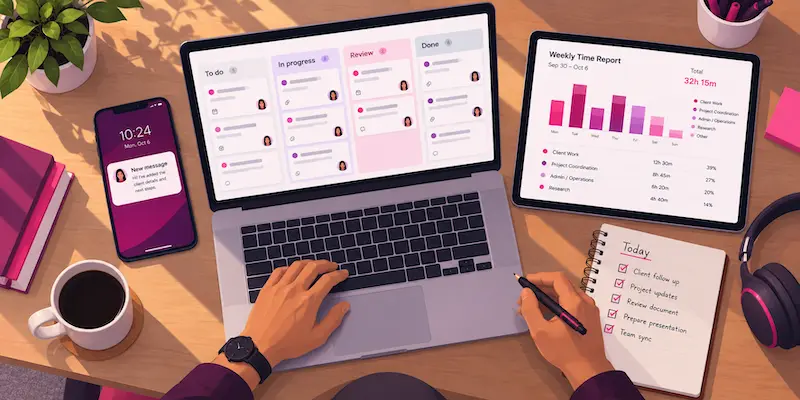
The right tools make your work visible, and that’s a good thing. When your progress is easy to track, and your contributions are clearly documented, you build credibility with your clients without constantly sending status updates. Your work speaks for itself.
Project management platforms
Tools like Asana, Monday.com, or Trello show who owns each task and when it’s due. When everyone can see the project board, accountability is built in because no one wants their tasks to show as overdue.
The specific tool matters less than using it consistently. Pick one of the best task management tools for virtual assistants and commit to it as your single source of truth for project status. If you’re comparing options, Zapier’s roundup of free project management software is a good place to start.
Time tracking software
Time tracking has a bad reputation, but it can work in your favor. It creates a clear record of your contributions, helps ensure you’re fairly compensated for your time, and gives your clients confidence in how projects are progressing. Used well, it protects and validates your work.
Offer time tracking as a collaborative tool. Use the data to talk with your client about capacity and priorities, not to prove you’re working.
Communication and video tools
Slack, Zoom, and Loom keep remote teams connected. They support accountability by making check-ins easy and reducing the friction of asking quick questions or sharing updates.
Loom works particularly well for asynchronous updates. A quick video walkthrough of completed work often communicates more than a written status report.
Documentation and knowledge bases
Shared documentation in tools like Notion or Google Docs creates accountability through visibility. When you document decisions, processes, and progress, everyone can see what’s been agreed upon and accomplished.
| Tool Category | What It Solves | Examples |
|---|---|---|
| Project management | Task ownership and deadlines | Asana, Trello, Monday.com |
| Time tracking | Workload visibility | Toggl, Clockify, Harvest |
| Communication | Quick alignment and check-ins | Slack, Zoom, Loom |
| Documentation | Transparent decision records | Notion, Google Docs, Confluence |
How Transparency Drives Remote Team Accountability
Transparency and accountability reinforce each other. When work is visible, people naturally take more ownership because they know others can see their contributions and commitments.
Clarify expectations during onboarding
Accountability starts on day one. Ask your client what success looks like in your role, how your work will be evaluated, and what communication norms you’re expected to follow.
Don’t assume anything is obvious. Ask for expectations in writing, even if they seem basic.
Establish regular check-in rhythms
Weekly one-on-ones and team syncs create natural accountability touchpoints. Frequency matters less than consistency. When you know you’ll discuss progress every Tuesday, you prepare accordingly.
Keep meetings focused on removing obstacles and aligning priorities, not on justifying your time.
Document decisions and progress visibly
When project status lives in a shared space, accountability is built in. No one wants their section showing “blocked” or “overdue” when the whole team can see it.
This visibility also reduces the need for status update meetings. Instead of asking “where are we on this?” your client can check the project board.
Create async-first communication norms
Asynchronous communication means exchanging information without requiring everyone to be online at the same time. Written updates in Slack or project management tools automatically document accountability.
When you post “Completed the client proposal draft, ready for review,” that’s a visible record of progress. It also respects different time zones and working styles.
Practical Strategies for Daily Remote Accountability
Theory is helpful, but what matters is how you put it into practice. Here’s how to translate accountability principles into your daily routine.
Set monthly and quarterly goals together
When you help define your own goals, you feel genuine ownership of achieving them. Don’t be afraid to have that conversation with your client. Ask what success looks like, share your perspective, and align on targets together. That kind of collaboration builds stronger working relationships and better results.
Frameworks like OKRs (Objectives and Key Results) connect your individual work to broader team and company goals.
Use daily standups or async updates
A brief daily check-in where you share what you completed, what you’re working on, and any blockers keeps everyone aligned. This can happen live in a quick video call or asynchronously through a Slack channel.
The key is brevity. Updates take two minutes, not 20.
Create clear handoff processes
Accountability often breaks down at transitions. When a task moves from one person to another, clearly define ownership at each stage. Ambiguity is where commitments slip, and where client trust starts to erode.
Balance sync and async work
Too many meetings drain your productivity, while too few can leave you feeling disconnected and out of the loop. Agree with your client on which topics need a live call and which can be handled with a written update or a Loom video.
How to Measure Your Remote Performance Effectively
Measurement keeps accountability grounded in facts, not feelings. Without clear metrics, it’s hard to know whether you’re truly meeting expectations or to advocate for yourself when you are. Defined deliverables give you and your client a shared language for success.
Review data collaboratively
Performance data works best when it sparks conversations, not punishment. Review metrics together with your client to identify improvements and celebrate wins.
Ask for consistent feedback
Regular feedback prevents small issues from becoming big problems. A quick note about a missed deadline is easier to address than a pattern that’s been building for months.
Track and share your wins
Positive reinforcement works both ways. Keep a running record of what you deliver, and share it in your check-ins. It shows the value of your work and sets a clear standard of accountability.
Overcoming Common Remote Accountability Challenges
Even well-designed systems run into obstacles. Anticipating common challenges helps you address them before they put a client relationship at risk.
Managing across multiple time zones
Time zone differences require planning. Identify overlap hours for synchronous collaboration, be flexible about meeting times when it makes sense, and invest heavily in async documentation.
Preventing isolation and burnout
Isolation can look like a failure of accountability, but it has different roots. Disengagement happens in all kinds of workplaces: Owl Labs’ 2025 State of Hybrid Work report found that 30% of remote workers feel disengaged, compared with 46% of office workers. Staying connected is part of staying accountable.
Build connection through virtual social time, regular one-on-ones, and genuine interest in the people you work with. Protect your energy too, since unmanaged burnout quickly shows up in your work.
Recovering when accountability breaks down
If you miss a deadline or a commitment slips, diagnose the root cause before you look for a fix. Was the expectation unclear? Was the workload unrealistic? Was there a personal issue affecting your performance? The answer determines the solution.
Then tell your client early, explain what happened, and share how you’ll prevent it from happening again.
How Cultural Alignment Strengthens Remote Accountability
Shared values make accountability easier. When you and your client align on work ethic, communication style, and professional standards, you spend less time clarifying expectations and more time doing meaningful work.
At Virtual Latinos, we understand that the best remote partnerships are built on shared values, a commitment to quality, clear communication, and mutual respect. When you join our community, you’re matched with U.S. businesses that don’t just need support. They’re looking for a true professional partner. That alignment makes accountability feel natural from day one.
Key Takeaways
- Define success with your client from day one. Agree on deliverables, deadlines, quality standards, and communication expectations so you can work independently with confidence.
- Make your contributions easy to recognize. Keep project statuses updated, document completed work, and use performance results to demonstrate your value.
- Communicate proactively without creating unnecessary meetings. Share concise progress updates, clarify priorities, and flag blockers before they affect deadlines.
- Use feedback to strengthen your professional growth. Review your performance with your client, acknowledge mistakes, and turn challenges into opportunities to improve.
- Build accountability you can sustain. Respect time zone agreements, set healthy work boundaries, and stay consistent to support long-term client relationships.

FAQs About Remote Team Accountability
What are the five C’s of accountability?
A common version of the five C’s is clarity, commitment, communication, collaboration, and consequences. The framework helps everyone understand expectations, agree to meet them, stay in touch about progress, work together effectively, and face appropriate outcomes based on performance.
What is work from home syndrome?
Work from home syndrome is a term often used for blurred boundaries between professional and personal life. Remote professionals sometimes struggle to “switch off,” leading to overwork and eventual burnout, or they swing the other direction into disengagement when home distractions take over.
How can you show clients you are accountable for your time?
Focus on deliverables rather than hours. Set clear expectations about what completed work looks like, use project management tools for visibility, and hold regular check-ins to discuss progress. This approach respects your autonomy while keeping you accountable for results.
What should you avoid as a remote professional?
Avoid unclear expectations, inconsistent communication, going quiet when problems come up, and treating flexibility as a reason to skip commitments. These behaviors erode trust and undermine the accountability you’re trying to build. If something slips, address it early through a direct conversation.
Start Building Accountability in Your Remote Career Today
Accountability in remote work isn’t about control. It’s about creating conditions where talented professionals can do their best work, and clients can trust you’ll meet commitments. With the right mix of trust, tools, and transparency, you become the kind of professional clients keep long-term.
Ready to build a remote career where your accountability is recognized and rewarded? Apply to join the Virtual Latinos community and get matched with U.S. businesses that value reliable, high-performing professionals.