
Imagine this: you’re sipping your morning coffee, laptop open, and your “office” is just a cozy corner of your living room.
For many Latin American professionals, that’s no longer just a dream—it’s everyday reality.
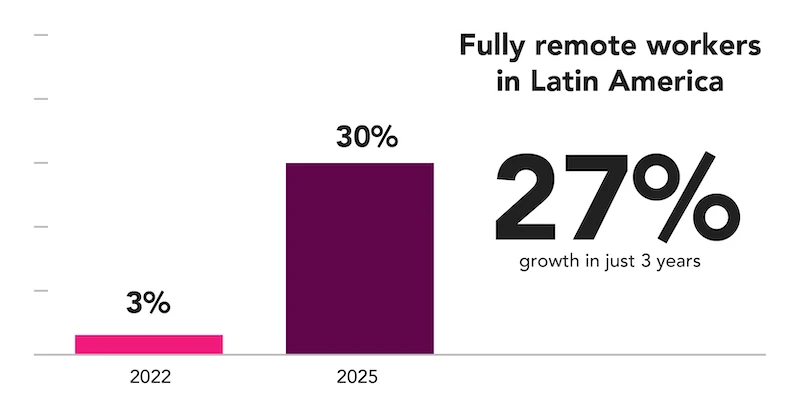
And the numbers prove it. In the past three years, the share of fully remote workers in Latin America has skyrocketed from just 3% to nearly 30%.
Remote work isn’t a niche trend anymore; it’s becoming a standard way of working across the region.
Still, with this rapid shift comes an important question: what does working fully remote really look like? Sure, it offers freedom and flexibility, but it also comes with challenges that can’t be ignored.
That’s why it’s worth exploring the pros and cons of working remote in detail. Let’s break them down together so you can decide whether this work style is the right fit for your career and lifestyle.
What Are The Most In-demand VA Jobs in 2025?
You might wonder: Are there Virtual Assistant (VA) roles outside of programming or marketing that are booming?
Absolutely. The acceleration of remote work, the rise of global freelance networks, and a growing focus on operational efficiency have elevated VA jobs into one of the most dynamic segments of the global outsourcing economy.
According to McKinsey, outsourcing-based service models are projected to grow by 38% by 2025, driven by cost optimization, flexibility, and digital adoption across industries.
Below are the most in-demand VA roles in 2025, supporting vital business functions far beyond tech:
Administrative and executive virtual assistants
These professionals are the backbone of remote business continuity. Their responsibilities include:
- Calendar management & meeting coordination
- Inbox triage & client communication
- Travel planning & file/document management
As global leaders operate across time zones, demand for virtual coordination continues to rise. Companies now depend on VAs to maintain structure and efficiency in hybrid work environments.
Skill focus: Time management, Google Workspace, Microsoft Outlook, Slack, and communication excellence.
Social Media & Content Virtual Assistants
Supporting consistent branding and digital engagement, these VAs focus on:
- Scheduling content across platforms
- Community engagement (DMs, comments)
- Basic SEO and analytics review
As of 2024, 5.07 billion people are active on social media—expected to grow in 2025. This growth underscores the urgent need for dedicated social media virtual assistants to maintain relevance and audience connection.
Skill focus: Canva, Buffer, Hootsuite, copywriting, keyword research, Meta Business Suite.
Bookkeeping & Real Estate Virtual Assistants
These specialized VA76 roles are both highly skilled and well-paid, focused on:
- Managing invoices, payroll, financial records
- CRM data entry and pipeline updates
- Property listings, viewing scheduling, and lead follow-up
Companies embracing leaner finance operations often turn to certified VAs for real estate and bookkeeping tasks—balancing accuracy and cost-efficiency.
Skill focus: QuickBooks, Xero, Zoho CRM, HubSpot, MLS systems (real estate-specific).
Why the Surge in Demand?
This is more than a trend—it’s strategic evolution. According to Forbes, using virtual assistants and remote staff can reduce operational costs by up to 70%, thanks to:
- Lower overhead (no office space or equipment)
- No insurance, benefits, or full-time obligations
- On-demand scalability for project-based support
Flexibility, multilingual reach, and global availability make VAs an ideal choice—especially for startups and SMEs.
Future Outlook for Aspiring VAs
The VA76 talent of the future will need hybrid skills: blending core admin abilities with specialized software expertise. Platforms like Coursera, Udemy, and LinkedIn Learning now offer certifications in tools such as:
- Notion
- ClickUp
- Trello
- Google Ads
These credentials not only boost employability, but also increase rates in competitive freelance platforms.

How Can Working as a Virtual Assistant (VA) Improve Your Career Prospects?
Let’s talk real benefits—with data to back it up.
Flexibility that fits your life
As a VA, you design your own schedule. Whether you want to work 20 hours a week or go full-time, the autonomy is yours.
This flexibility allows you to balance personal responsibilities, upskill, or pursue other professional goals without the constraints of a traditional 9-to-5.
According to Forbes, flexibility is now one of the top drivers of job satisfaction among remote workers.
Diverse skill-building = Career leverage
Virtual assistants rarely do just one thing. You may find yourself editing blog content, managing social media calendars, conducting research, or coordinating virtual meetings—all in one week.
This broad exposure helps you develop what recruiters call T-shaped skills: deep expertise in a few areas plus working knowledge in many others.
According to Harvard Business Review, this type of skill set is increasingly valuable in dynamic, digital workplaces.
Personal brand + Online presence
A strong digital presence is a proven asset for freelancers. According to a study by the Oxford Internet Institute, digital gig workers often depend on online profiles, portfolios, and visibility to secure clients and build trust.
Maintaining personal websites or professional profiles on platforms like LinkedIn, Behance, or GitHub helps freelancers stand out in competitive marketplaces and signals credibility to potential clients.
A Booming Global Market
The global virtual assistant market was valued at USD 5.82 billion in 2020 and is expected to reach USD 47.57 billion by 2028, growing at a CAGR of 30.5% from 2021 to 2028.
This growth is driven by increased adoption of AI-powered virtual assistants in customer service, healthcare, and business operations.
Latin America: A Remote work hotspot
Latin America is rapidly consolidating itself as a hub for remote talent. According to the OECD, over 25% of jobs in the region can be performed remotely, particularly in knowledge-intensive sectors such as IT, professional services, and creative industries.
This shift is supported by significant improvements in digital infrastructure and a young, tech-savvy workforce.
Pros and Cons of Working Fully Remote
Remote work is no longer just a pandemic response—it has become a permanent feature of the global labor market.
Advances in digital infrastructure, collaboration tools, and shifting employee expectations have enabled millions to work from home, co-working spaces, or even across borders.
Let’s break it down with clarity. You know what to expect—and how to lean into the good stuff.
Pros
- Cost savings:
Remote workers can save up to $6,000 annually by cutting commuting, meals, and office expenses, while companies reduce overhead costs. - Flexibility in work environment:
Whether at home, a co-working hub, or even abroad, employees can design their own productive setups. - Productivity:
A McKinsey 2022 survey found that 58% of employees reported higher productivity in hybrid/remote models. - Work–life balance:
OECD notes that remote work helps reduce commuting stress and improves life satisfaction—when managed with clear boundaries. - Global opportunities:
Remote jobs open access to international employers, allowing talent in Latin America, Asia, and Africa to compete in global markets. - Professional branding:
Freelancers and VAs benefit from platforms like LinkedIn and Behance, where 70% of employers check online portfolios before hiring.
Cons
- Isolation and lack of interaction:
About 16% of remote employees report loneliness, highlighting the need for intentional community building. - Blurred work/life boundaries:
Gallup research shows that 27% of remote workers struggle to disconnect, leading to longer working hours. - Team cohesion challenges:
McKinsey warns that without deliberate practices, remote teams may lose informal collaboration (“water cooler” moments). - Self-discipline required:
Lack of office structure means remote workers need stronger routines to avoid procrastination or burnout. - Setup costs and distractions:
Investments in high-speed internet, ergonomic furniture, and dedicated spaces are necessary. Home environments can also bring interruptions.
Comparative Summary Table
| Aspect | Pros | Cons |
| Costs | Saves up to $6,000/year | Initial setup |
| Flexibility | Choice of workspace, time management | Risk of blurred boundaries |
| Productivity | 58% report higher productivity | Risk of procrastination or overwork |
| Work–Life Balance | Less commuting stress | 27% struggle to disconnect |
| Opportunities | Global job access | Harder to build team cohesion |
| Professional Growth | Stronger digital brand | Limited in-person networking |

FAQ: Frequently Asked Questions
1. What skills do you need to become a VA?
You’ll stand out with:
- Strong written and verbal English
- Organization and reliability
- Tech savvy: email, Google Suite, basic project tools
- Specialized skills (social media, bookkeeping) help a lot.
2. Can I work as a VA without a degree?
Absolutely! Though 60% of VAs have college degrees, what truly matters is that you can deliver quality work and hit deadlines.
3. Where can I find remote VA jobs?
- Freelance platforms like Upwork, Fiverr
- Virtual Latinos network (hint, hint!)
- Social media groups and LinkedIn job boards
- Agencies and remote staffing firms looking for LatAm talent
Pros and Cons of Working Remote: Your Career Advantage
Working fully remote is no longer a perk—it’s a career path shaping the global workforce. While it brings undeniable advantages like cost savings, flexibility, and access to worldwide opportunities, it also carries challenges such as isolation, blurred boundaries, and the need for greater self-discipline.
At Virtual Latinos, we help you navigate this landscape and turn challenges into opportunities. What sets us apart?
- Exclusive talent pool: Only the top 1% of applicants are accepted after a rigorous vetting process.
- Human-guided hiring: Our team works with you to match not just skills, but also culture and long-term goals.
- VL Academy: Ongoing free training programs ensure VAs stay ahead with up-to-date digital and professional skills.
- Thriving community: With over 10,000 professionals in the VL community, our VAs are supported, engaged, and more likely to thrive long-term.
The key takeaway? By partnering with the right platform, you can amplify the benefits, reduce the risks, and build a sustainable, fulfilling career.
Ready to take action? Discover how the pros and cons of working remote can shape your future, explore VA roles, and start building a flexible career that fits your lifestyle now.